Skip to menu
Skip to content
Skip to footer
Menu
Study
Research
Partners and community
About
Search
Queensland Brain Institute
Home
About
About
Vision statement
Partners
Annual reports
Our people
Our people
Research leaders
Early and mid-career researchers
Equity, diversity and inclusion
Research
Research
Groups
Facilities
Centres
Discovery science
Participate in research studies
Study
Study
Higher Degree by Research
Honours
Research programs
Projects for coursework
Non-UQ students
The Brain
The Brain
Brain anatomy
Cognition and Behaviour
Disorders and Injuries
Engage
Engage
Events
Podcasts
The BRAIN magazine
Community Outreach
News
Give
Give
Ways to give
Regular giving
Gift in your will
Gift in memory
Give for the future
Philanthropic partnerships
Corporate partnerships
Fundraise for QBI
Contact
Study
Research
Partners and community
About
UQ home
News
Events
Give
Contact
Search term
UQ home
News
Events
Give
Contact
Queensland Brain Institute
Menu
Home
About
Show About sub-navigation
Vision statement
Partners
Annual reports
Our people
Show Our people sub-navigation
Research leaders
Early and mid-career researchers
Equity, diversity and inclusion
Research
Show Research sub-navigation
Groups
Facilities
Centres
Discovery science
Participate in research studies
Study
Show Study sub-navigation
Higher Degree by Research
Honours
Research programs
Projects for coursework
Non-UQ students
The Brain
Show The Brain sub-navigation
Brain anatomy
Cognition and Behaviour
Disorders and Injuries
Engage
Show Engage sub-navigation
Events
Podcasts
The BRAIN magazine
Community Outreach
News
Give
Show Give sub-navigation
Ways to give
Regular giving
Gift in your will
Gift in memory
Give for the future
Philanthropic partnerships
Corporate partnerships
Fundraise for QBI
Contact
Flight
Left or right? Honeybees have a preference for flight direction
Published on:
3 November 2017
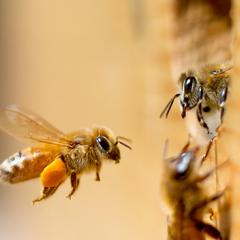
Humans are mostly right-handed, and primates, cats, dogs and even budgies show handedness, but now for the first time, researchers have shown that bees have a preference for sides too.
Budgies provide crash course in flight safety
Published on:
29 September 2016
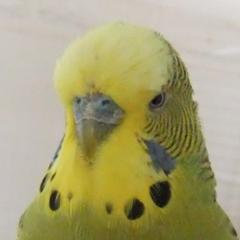
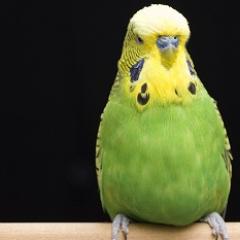
Birds avoid crashing into each other by always veering right, QBI research finds, which may aid technology to stop mid-air plane collisions.
Bird-brained flight provides clues for robotics
Published on:
23 June 2016
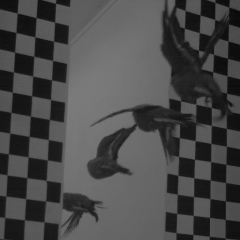
Research into how birds plan their flights has applications for drones and aircraft navigation systems.
Scholarship winner takes flight
Published on:
7 December 2015
The 2015/16 Aleks Brumby Summer Research Scholarship recipient, UQ's Tas Jouir, will research aerial navigation systems at QBI.
Learning about the birds and the bees helps aid flight
Published on:
10 June 2015
Research into how birds and bees use vision in flight is guiding the design of future autopilots and unmanned aerial vehicles.
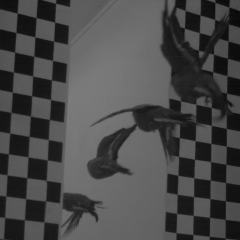
Bird brains may help drones fly and avoid crashing
Birds have a remarkable ability to fly through complex environments with incredible speed, rarely colliding.
Research Area
Ageing
Agenesis of the corpus callosum
Alzheimer's disease
Anxiety
Artificial Intelligence
Attention
Autism
Brain Bee Challenge
Brain stimulation
Brain tumour
C.elegans
Circuits, Systems & Computational Neuroscience
Cognition
Cognitive, Behavioural & Sensory Neuroscience
Colour
Computational neuroscience
Concussion
Deep Brain Stimulation
Dementia
Depression
Epilepsy
Exercise
Fish
Flight
Genetics
Genomics
Hormones
Learning
Memory
Mental health
Microscopy
Motor neurone disease
Nerve regeneration
Neurodevelopmental Disorders
Neurogenesis
Neuroimaging
Parkinson's disease
Psychology
Schizophrenia
Sleep
Spinal cord injury
Stem cells
Stroke
Synaptic, Cellular & Molecular Neuroscience
Traumatic Brain Injury
Vision
Visual perception
Vitamin D