
Throughout his career, Professor Jason Mattingley has received hundreds of emails from students wanting to join his lab to study cognitive neuroscience. But never one quite like the email he received from Richard Ronayne.
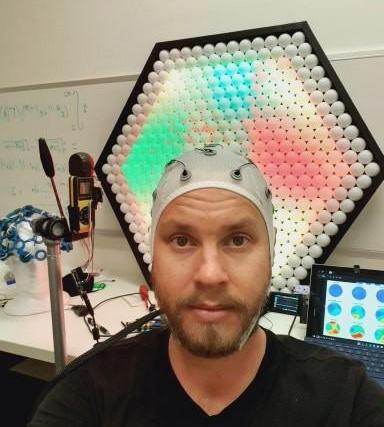
In 2021, Jason opened Richard’s email to see him wearing a home-made electroencephalograph (EEG), a device used to measure the brain's electrical activity. Richard had mostly built it himself to collect data for an undergraduate experiment.
Fast forward five years, and Richard is working in the Mattingley lab, using virtual reality (VR) technology to immerse people in a world they can explore to test how their episodic memory changes over time.
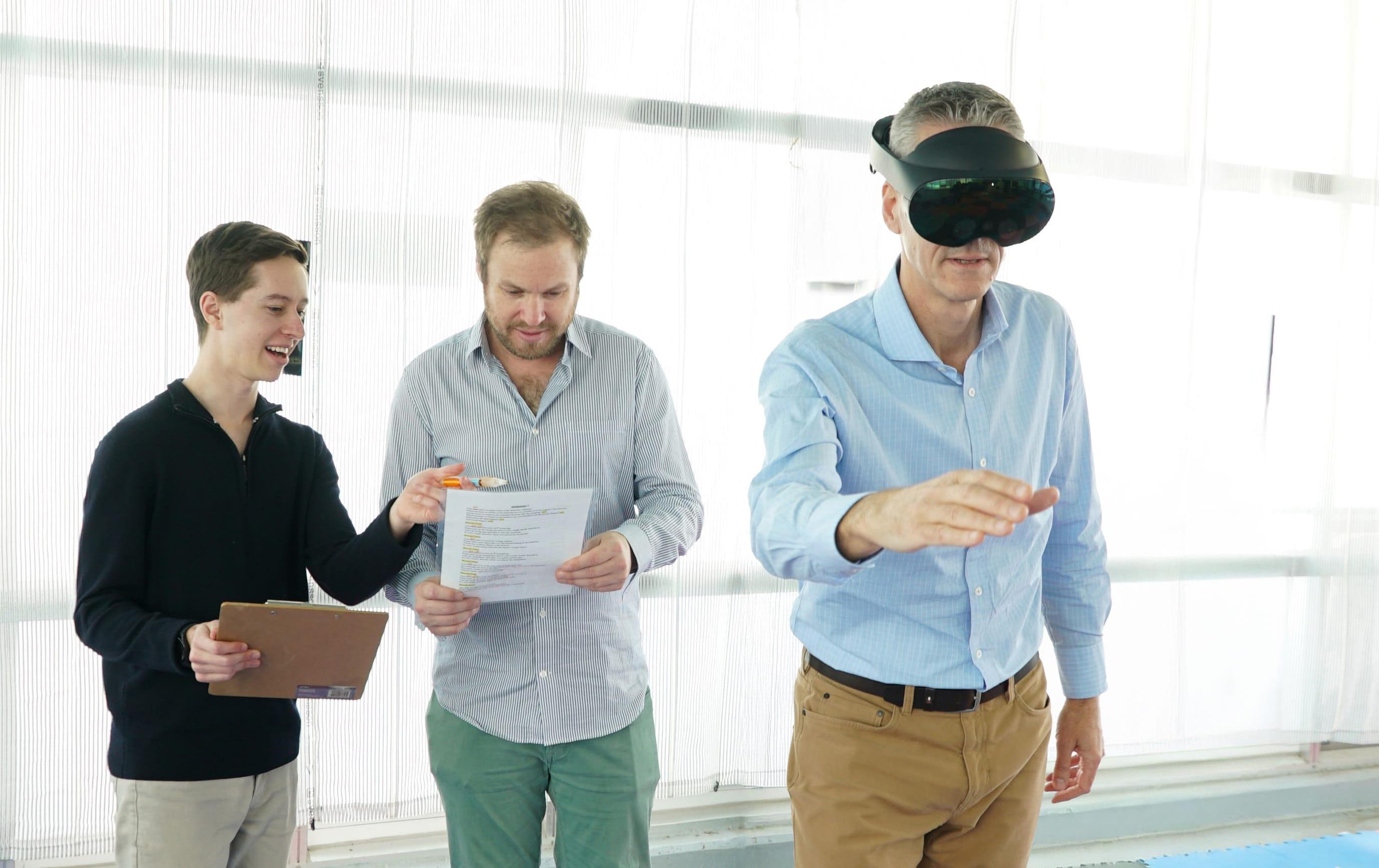
We asked Richard and Jason to reflect on their journey so far.
Q: Richard, did you always want to be a scientist?
Richard: I haven’t always wanted to be a scientist, but that’s because I didn't really know what a scientist was until I started uni. It was a very happy coincidence that I found neuroscience as a new career, and I am very lucky to have the amazing experience and support of Jason. I have always been very interested in how things work. Which, I guess, is basically the heart of what science is. It’s just the way you accurately figure out how things work.
Jason: Were you one of these children who liked to pull things apart to see if you could get them back together again?
Richard: (laughs) Oh, yeah. Pulling things apart was great. But I knew that as soon as a spring came out, it was never going back together.
In the mines, I was an instrumentation electrician. My job was to verify and troubleshoot sensitive field equipment so that it sent accurate signals to a central computer. This is critical to get right so valves, boilers, pumps, turbines, etc. operate correctly and safely.
Q: How did you make the decision to leave the mines and become a scientist?
Richard: FIFO work is lonely, and I was never in one place for more than three to six months. That's what really put me off a mining career altogether. I thought, “How can I start a family if I’m never at home?” So, I knew I needed a career change. I thought, “I have always been fascinated by how our minds work, why not do a degree in psychology and become a psychologist?” It wasn’t until my second year at uni that I learned about neuroscience. I remember we did a lecture about EEG, and I thought, “This is exactly like my old career. It’s complicated electronics talking to a computer where accurate output is critical.” This would give me the opportunity to change to a career where my existing skill set is a huge advantage.
Q: Jason, what impressed you most about Richard’s background?
Jason: I still remember getting that email from you, Richard. I think you'd just finished your honours year, and I didn't know anything about you. In fact, I wasn't looking for a new PhD student. I remember you told me you'd done an EEG study for your honours, but there was a twist: you didn't have access to an EEG, so you built your own. You showed me pictures of your own homemade EEG setup, which was just superb.
Richard: I knew that to go straight from honours into a PhD in a cool institute like QBI, I needed to pull out all the stops. So, I thought, “Let’s design an experiment that really shows off my electrical skills in the hopes that it impresses the right supervisor.”
Q: Jason, what do you look for in a PhD student?
Jason: Someone who's a problem solver. I think one of the key elements of being a good PhD student is overcoming adversity. Richard has those characteristics. His previous role involved a lot of troubleshooting. He’d go to a mine site where the system wasn’t working, and he’d have to start from scratch, work out what the problem was, and fix it. That’s exactly the skillset you use as a scientist.
You’ve got something that’s unknown, you design an approach to investigate that unknown problem, and you troubleshoot all the way through until you find answers.
It’s fantastic to see how a skillset like that can translate seamlessly into science.
Q: Richard, tell us about Jason’s mentorship and his approach to nurturing your curiosity.
Richard: To get here from non-science, you've got to have a burning, explosive curiosity. I think that's where I've really appreciated and needed Jason’s mentorship to help me keep one foot on the ground. While curiosity is great, and we should nurture it, we've also got to produce scholarly results. As much as I'd love to spend all day experimenting and tinkering with ideas, Jason’s guidance has been the reality check I’ve been missing.
Jason: Yes, I'm the one who tells you “No” when it looks like you've gone down too many rabbit holes. I'm the one who pulls you back out and brings you back to reality.
Richard: (laughs) I don't know if “No” is the right word. “Keeping me focused on achieving the current goal” is a better way to put it.
Jason: As a PhD supervisor, what I look for is somebody who's got curiosity, but research should be done in a way that's pragmatic and a way that leads to outcomes.
Q: Tell us about your VR project and its benefits in understanding memory.
Jason: Richard knocked on my door one day and said he wanted to do a PhD looking at episodic memory. Both of us recognised that using the static, traditional test was not the way we wanted to go. We wanted to generate a more dynamic, verifiable way to assess people’s memory.
The beauty of VR is that I can put a person into an environment I’ve constructed, so I know everything the person experienced. If I ask the person a day or a week later about something they’ve experienced in that world, I know exactly whether they are recalling it correctly. I think both of us realised that VR was the way to study this scientifically. It would open up opportunities to verify what people experienced and allow control over what they experienced, which is a gap in this field of research.
Richard: Exactly, we have cells in our brain that interpret time, space, and even how we turn our head, which all contribute to our episodic memory. Traditional pen and paper memory tests don’t measure that, so they often measure our memory in a very different way from how we use it.
I think using VR also helps identify and communicate the benefits of various episodic memory-based treatments. The results are much more intuitive to the public in how they understand their own memory, compared to test metric jargon.
Q: What’s next for this research?
Richard: This research offers current researchers a new tool to help determine the effectiveness of new drugs/treatments for dementia, and it has real potential to be developed into a new clinical metric that GPs could administer when assessing a patient’s memory.
Then the clinician could make a more informed diagnosis or even help them apply new strategies to compensate for deficits identified by the VR test. I would love to explore the possibility of turning this VR research into a real tool that can help doctors and patients worldwide better understand episodic memory.
If you’d like to hear Richard talk more about his VR memory research, listen to QBI’s A Grey Matter podcast here.


