The diseases we research impact people's lives
Our researchers are dedicated to improving lives through neuroscience. Thanks to the generosity of all our donors, that we can continue our legacy of ground-breaking research.
Brazil Family Foundation
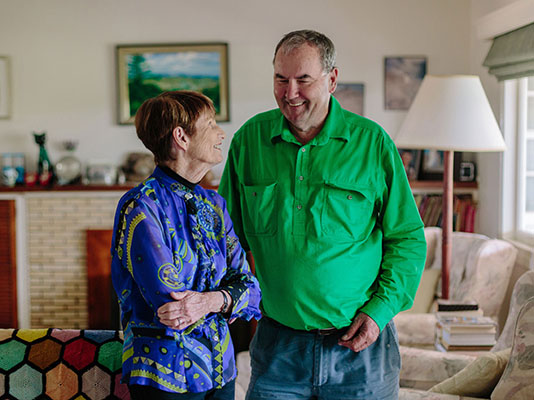
Recognising stroke and motor neurone disease (MND) had only limited treatment options and no cures prompted Lyn and Bobbie Brazil to establish the Brazil Family Program for Neurology in 2017. This enabled us to recruit world-leading researchers and support four laboratories.
Dr Adam Walker’s laboratory has defined some of the early triggers of MND to enable the best targeted approaches for therapies and identified ways to prevent the abnormal accumulation or improve the removal of a protein that causes motor neurons to die.
Dr Tara Walker is examining whether the dietary supplement selenium can prevent or decrease cognitive or motor deficits following stroke.
Dr Matilde Balbi aims to understand how stimulating the cortex in different ways reduces the loss of brain cells after a stroke and whether this mitigates behavioural deficits.
Professor Gail Robinson’s stroke research aims to improve cognitive assessment tests used to evaluate stroke survivors, in the acute phase, to predict long-term outcomes and to develop more targeted, personalised therapy strategies. Professor Robinson also aims to improve our understanding of the biological basis of MND.
The Brazil Family have also donated generously to our Alzheimer’s disease research. This gift contributed to Professor Jürgen Götz and his team’s ground-breaking therapeutic ultrasound approach to target dementia. This research has identified a range of potential applications for ultrasound, including delivering drugs into the brain. The intention is to modify disease progression and ultimately cure brain diseases.
Discovery research leads to the health outcomes of the future, but it takes time and support. Researchers need preliminary data to support their applications for grants. With government grant funding becoming harder to secure , scientists with promising research potential are being lost.
Funding of researchers who narrowly miss out on government grant funding could hold the key to major breakthroughs and, with support, could continue to explore new avenues and build the data needed to be successful in subsequent grant rounds.
The Brazil Family Foundation understands the power of “near-miss” applications and are supporting our scientists with a gift which enables them to continue collecting valuable data to improve their grant success in future funding rounds.
The whole of the QBI community pays tribute to the Brazil Family Foundation whose generosity and support enables us to continue our pathway to expanding our understanding of the brain, the underlying causes of brain disease and help develop new treatments which will benefit the community at large.
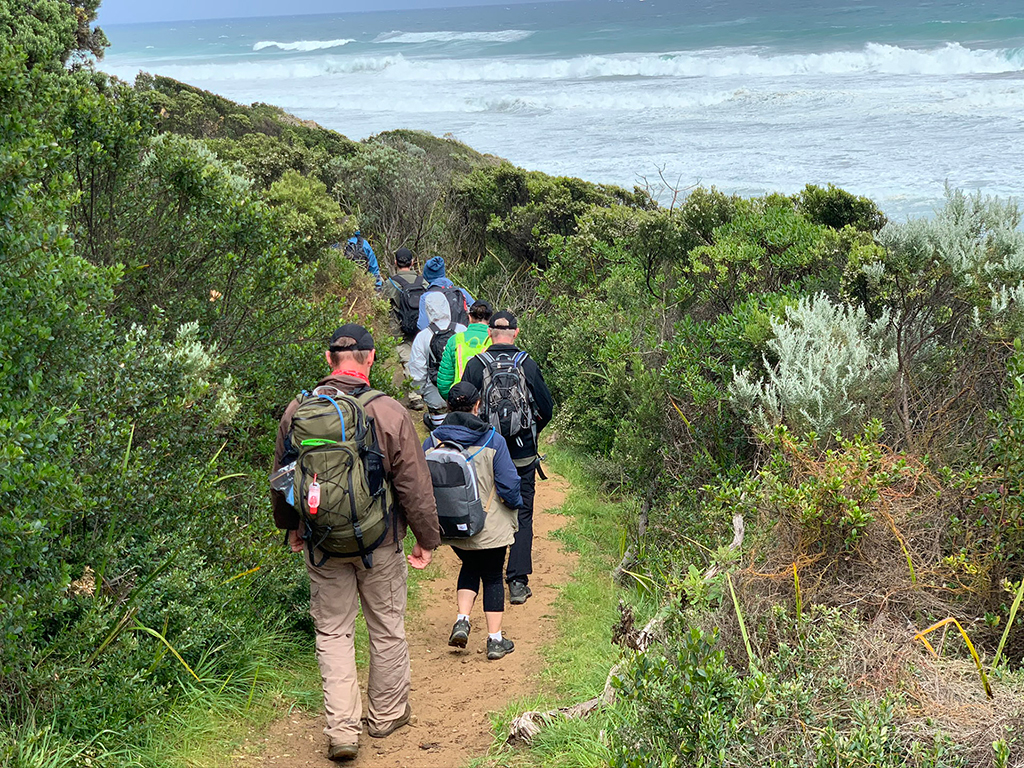
Great Ocean Walk, raised over $125 000 to support
brain research.
NFIA Trekkers do the hard yards for QBI
Through the hard work of Brian Davies, a successful businessman and immediate past-president and patron of the National Fire Industry Association (NFIA), and his wife, Liz, QBI was the joint-recipient of a donation of over $250 000 in 2019.
This incredible effort was the result of the NFIA Patron’s Walk held in October, which may sound like a scenic walk in the park but Brian, Liz and seven other NFIA members spent three days enduring driving rain and winds of close to 50 knots coming straight from Antarctica.
The idea for the walk came while the couple were completing the Three Capes Walk to raise money for the Queensland Brain Institute in 2018.
On that walk, Liz suggested to Brian that as the patron of the NFIA, he could create his own walk for charity. Mr Davies believes that corporate Australia has a big responsibility to give back, which is testament to the success of the inaugural walk. The money raised was shared between the Queensland Brain Institute and the Gallipoli Medical Research Foundation (GMRF).
The NFIA walk is the first of three walks to raise money for research at QBI and GMRF, with the aim of raising $500 000 in three years. The donation from the NFIA walk will help QBI’s research into motor neurone disease, dementia, Parkinson’s disease, stroke and QBI’s Discovery Research Endowment fund, which enables fundamental research into major health issues, including depression, anxiety, PTSD and epilepsy. QBI is extremely grateful to Brian and Liz and the NFIA team for their support.
The NFIA walk is the first of three walks to raise money for research at QBI and GMRF, with the aim of raising $500 000 in three years.
The Stafford Fox Medical Research Foundation
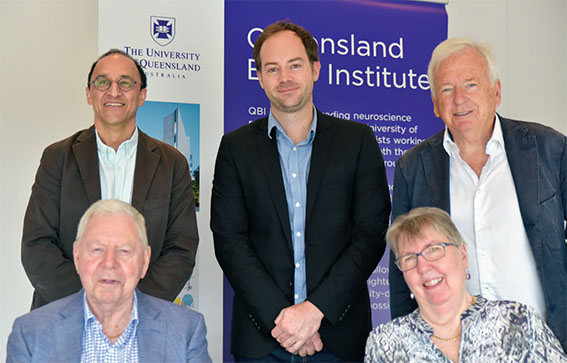
(QBI Director) and Dr Steven Zuryn and Emeritus Professor Perry Bartlett AO (back row).
In 2019, The Stafford Fox Medical Research Foundation confirmed its continued generous support of the prestigious $2.5 million philanthropically funded international fellowship to Dr Steven Zuryn at the Queensland Brain Institute to fight stroke-induced dementia, also known as vascular dementia. The Foundation also continues to support the work of Emeritus Professor Perry Bartlett’s research into prevention of dementia in ageing by improving cognition through exercise.
The Stafford Fox Medical Research Foundation was established in 2013 following the death of Moyna Fox, and named in honour of her late husband, James Stafford Fox, a former BP Australia chief executive.
Stafford and Moyna Fox started one of Australia’s wealthiest medical research foundations after many years of careful planning, resulting in a fund worth over $100 million. It was only publicly revealed in Moyna’s will when she died in 2013, many years after her husband.
James Stafford Fox was a private person, tall, physically imposing, but without a, particularly dominant personality. He rose from a position as a junior clerk at the Port Melbourne depot of the Commonwealth Oil Refineries (COR) in 1932, to become the first Australian chief executive of BP Australia Ltd in 1971.
James Stafford Fox spent three years at the helm of BP Australia, and retired in 1974 at age 60, remaining on several boards until 1985. By 1990, he was in poor health, suffering, among other things, from dementia. He entered a nursing home and died in 1994. By that time, he had already charted the course that would lead to the establishment of the foundation. Moyna lived on for more than 18 years, knowing what would happen after her death, but never revealing it publicly. Eventually, she too succumbed to dementia and died in 2013. The couple, who were so careful with their money and who clearly had no desire for fame and prominence during their lifetime, will now forever be remembered for their generosity in setting up the Stafford Fox Medical Foundation.
The Foundation’s support of QBI is crucial in enabling Emeritus Professor Bartlett and Dr Steven Zuryn to continue their work in finding solutions for the growing challenge of dementia today. This cutting- edge research is helping put Queensland and Australia at the forefront of world medical research.
What your donations fund
Your support can help us achieve a range of achievements

World leading research

Brightest scientific minds

Solutions to global health challenges
"I think it is important for people with dementia, their families and carers, to know that they are not forgotten, and that there’s a lot of work going on behind the scenes at QBI to try to unravel the tangled web that is dementia."
– Robyn Hilton (established the Peter Hilton Senior Research Fellowship in Ageing Dementia)
Hear from one of our supporters
Jeff Maclean, Chair of QBI Advisory Board

Got a story you would like to share?
Are you a donor or supporter of QBI and would like to share your story? We would love to hear from you!
Research in action
- 3 Apr 2019Join us for an informative breakfast session highlighting MND research at the Queensland Brain Institute.
- 16 Aug 2018–18 Aug 2018Understanding how neuronal activity and synaptic function produce and are shaped by behaviour is a fundamental goal of neuroscience. Similarly, improved treatments for mental and neurological disorders will rely on gaining a better appreciation for how the brain coordinates activity across synaptic, circuit and system scales. This short conference brings together academic, industry and clinical leaders to discuss the latest advances in these areas.
Balbi team
Group Leader
Dr Matilde Balbi
Senior Research Fellow and Group LeaderQueensland Brain InstituteResearcher profile is public:0Supervisor:Researcher biography:Dr. Matilde Balbi is a neuroscientist within the Queensland Brain Institute, The University of Queensland. After receiving her bachelor and master's degree in Medical Biotechnology from the University of Naples,Italy, she spent a year working on traumatic brain injury at the Royal College of Surgeons in Ireland as a research assistant. Dr. Balbi earned her Ph.D. in Neuroscience at the Ludwig Maximilians University in Munich, Germany, working on the regulation of cerebral blood flow in health (ageing) and disease (small vessel disease and subarachnoid haemorrhage). She completed her postdoctoral training at the University of British Columbia in Vancouver, Canada, where she received support and fellowships from the Leducq Foundation, CPSR, MSFHR. She now leads her laboratory which aims to make an impact on the field of stroke recovery and other pathological conditions by combining imaging techniques, brain stimulation and individually tailored recovery paradigms in behaving rodents.
Body: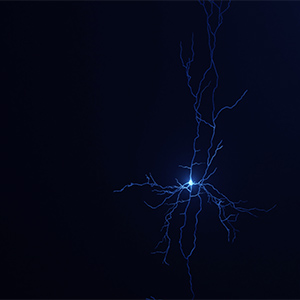 Balbi: Neuromodulation and homeostatic processes
The Balbi lab employs a multi-level approach, combining in vivo imaging techniques, brain stimulation—including but not exclusively optogenetics—and AI driven, individually tailored recovery paradigms in behaving rodents, to investigate intrinsic neuroprotective mechanisms of the brain under pathological conditions such as stroke.
Postdoctoral Researchers
Dr Barbora Fulopova
Research FellowQueensland Brain InstituteResearcher profile is public:0Supervisor:Researcher biography:Dr. Fulopova is an early career Postdoctoral Research Fellow at the Queensland Brain Institute (QBI), The University of Queensland (UQ), focusing on research promoting neural adaptation in health and disease. Dr. Fulopova received PhD in Medical Studies (Neuroscience) in 2021 at the Wicking Dementia Research and Education Centre, University of Tasmania. During her doctoral candidature Dr. Fulopova developed expertise working in preclinical animal models, combining cutting edge in vivo imaging, neuromodulation and behavioural assays to investigate presynaptic axonal pathology, and how this could be ameliorated in dementia associated neurodegeneration. In her current postdoctoral work, Dr. Fulopova applies neurophysiological techniques using both ex vivo patch clamp recordings as well as in vivo optical calcium imaging and extracellular microelectrode recordings to study recovery of neural circuits connectivity following stroke and neurodegeneration.
Dr Dongsheng Xiao
Postdoctoral Research FellowQueensland Brain InstituteResearcher profile is public:0Supervisor:Researcher biography:My research has centred on elucidating the neural mechanisms underlying complex sensorimotor functions and motor learning through an interdisciplinary blend of cutting‐edge neuroscience and advanced computational methods. Early in my career, I pioneered the use of intraoperative microelectrode recording and stimulation to map the basal ganglia and thalamus, enabling precise modulation of motor functions via deep brain stimulation. Driven by my research interests, I embarked on a PhD journey in Prof. Tim Murphy's lab at the University of British Columbia (UBC) where I was honoured with the Scholarships from the International Alliance of Translational Neuroscience. Prof Tim Murphy's lab develops cutting-edge neurophysiological techniques to probe the complex information flow in the brain during sensorimotor processing. I co-led the development of intact skull chronic windows for mesoscopic wide‐field imaging in awake mice, a now widely adopted technique described in Silasi, Xiao et al., 2016 (co-first author, 241 citations). I also pioneered methodologies for mapping functional connectivity between cortical mesoscopic networks and subcortical single spiking neurons (Xiao et al., 2017. 151 citations). My research integrates artificial intelligence and computer vision to automate the exploratory analysis of the rich neural and behavioural video datasets. I have combined chronic, simultaneous wide‐field imaging, multi‐site electrophysiology using the Mesotrode (Xiao et al., 2023), and advanced machine learning tools (e.g., MesoNet, Xiao et al., 2021, Nat. Commun.) to capture and quantify large‐scale neuronal spatiotemporal patterns associated with a specific motor act, such as self-initiated running, reaching and orofacial movements. I also co-developed a 3D virtual mouse model that translates 2D behavioural videos into a 3D model space, enabling more detailed analysis of mouse behaviours, and established a standardised behavioural framework to disentangle movement dynamics from unrelated factors. This work was featured on the cover of Nature Methods (Bolaños, Xiao et al., 2021. co-first author). I contributed to the development of real-time systems for selectively tracking mouse body movements. This work paves the way for advanced "closed loop" brain-computer interfaces, facilitating understanding of the neural basis of behavioural control (Forys, Xiao et al., 2018, 2020. co-first author). My recent work in the Balbi lab at the University of Queensland on continuous auditory feedback demonstrates that real-time, movement-coded auditory cues can significantly accelerate fine motor skill learning in mice (Xiao and Balbi, eNeuro), exemplifying how augmented sensory input can promote motor performance. Similarly, my contributions to real-time EEG-based asynchronous error prediction in human–robot interaction using machine learning (Xiao et al., under revision) and the development of MesoGAN—a Generative Adversarial Network (GAN) framework that generates realistic behavioural videos from neural decoding of wide-field cortical calcium dynamics (Xiao et al., under revision)— highlighting my commitment to bridging neuroscience with adaptive robotics and AI.
Dr Montana Samantzis
Postdoctoral Research Fellow/Research OfficerQueensland Brain InstituteResearcher profile is public:0Supervisor:Students
Mr Victor Vasquez Matsuda
PhD StudentQueensland Brain Institute, UQResearcher profile is public:0Supervisor:Mr Dinglu Peng
PhD StudentQueensland Brain InstituteResearcher profile is public:0Supervisor:Miss Chantelle Jackson
PhD StudentQueensland Brain InstituteResearcher profile is public:0Supervisor:Tahlia Melrose
Honours StudentQueensland Brain InstituteResearcher profile is public:0Supervisor:Divyang Chovatia
Honours StudentQueensland Brain InstituteResearcher profile is public:0Supervisor:Karly Rostrom
Honours StudentQueensland Brain InstituteResearcher profile is public:0Supervisor:Ty Brennan
Honours StudentQueensland Brain InstituteResearcher profile is public:0Supervisor:
Pages
Connect with us