
Understanding how the brains and sensory systems of animals in the real world have been shaped by their environment and behavioural needs
With questions such as, Why are shrimps like satellites? Why are reef fish colourful? and Why are octopus colour blind?, research in the Marshall laboratory is focussed on visual neuroscience and visual ecology in Australia’s vibrant marine environment.
Sometimes called Neuroethology this field of research involves both lab and field-based neuroscience. It aims at understanding how the brains and sensory systems of animals in the real world have been shaped by their environment and behavioural needs.
Group leader

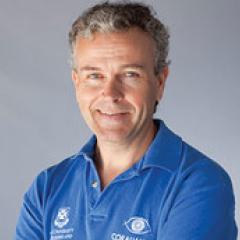
Professor Emeritus Justin Marshall
Group Leader, Sensory neurobiology group
+61 7 334 51397
justin.marshall@uq.edu.au
UQ Researcher Profile
@ecovisuq
Marshall Lab
Sensory Neurobiology Group website
CoralWatch
-
How do the 20-channel of information eyes of the mantis shrimp visual system efficiently encode information to the brain? Is there a form of sparse code at play? What can this teach us about more efficient and rapid ways to examine our own planet (assuming mantis shrimps are from another one).
-
The ring-shaped and dispersed cephalopod brain is designed very differently to that of the vertebrates or indeed other invertebrates. However, their cognitive abilities rival medium sized mammals (your dog or cat); so how does this different brain design achieve the same complexity of behaviour?
-
Anemonefish (Nemo) are brightly coloured and can see UV. Why – what are the colours and extended vision for?
The mechanisms behind colour vision and polarisation vision in fish, stomatopod crustaceans and the cephalopods have been a focus in the last few years with important discoveries published in top-tier journals such as Science, Nature journals, Current Biology, and Current Opinion in Neurobiology.
An astonishing parallel between insect and crustacean brains has been unearthed by Hanne Thoen and co-workers. Gene duplication and anatomical specialisation in fish, discovered by Fabio Cortesi, Fanny de Busserolles and co-workers, is helping us realise fish colour vision is far more comprehensive than previously thought. The cephalopod team led by Wen-Sung Chung is using new brain imaging methods to unlock the secrets in the brains of octopus squid and cuttlefish, the world’s most intelligent invertebrates. Our resident engineer, Sam Powell is investigating how the mantis shrimp visual system can help with GPS denied navigation underwater – without the need to surface.
- Mitchell, Laurie J., Cortesi, Fabio, Marshall, N. Justin and Cheney, Karen L. (2023).Higher ultraviolet skin reflectance signals submissiveness in the anemonefish, Amphiprion akindynos. Behavioral Ecology, 34 (1) arac089, 19-32. doi: 10.1093/beheco/arac089
- Fogg, Lily G., Cortesi, Fabio, Gache, Camille, Lecchini, David, Marshall, N. Justin and de Busserolles, Fanny (2023).Developing and adult reef fish show rapid light‐induced plasticity in their visual system. Molecular Ecology, 32 (1), 167-181. doi: 10.1111/mec.16744
- Chung, Wen-Sung, López-Galán, Alejandra, Kurniawan, Nyoman D. and Marshall, N. Justin (2023).The brain structure and the neural network features of the diurnal cuttlefish Sepia plangon. iScience, 26 (1) 105846, 1-18. doi: 10.1016/j.isci.2022.105846
- Stieb, Sara M., Cortesi, Fabio, Jardim de Queiroz, Luiz, Carleton, Karen L., Seehausen, Ole and Marshall, N. Justin (2022).Long-wavelength-sensitive (lws) opsin gene expression, foraging and visual communication in coral reef fishes. Molecular Ecology, 32 (7), 1656-1672. doi: 10.1111/mec.16831
- Cronin, Thomas W., Porter, Megan L., Bok, Michael J., Caldwell, Roy L. and Marshall, Justin (2022).Colour vision in stomatopod crustaceans. Philosophical Transactions of the Royal Society B: Biological Sciences, 377 (1862) 20210278, 1-11. doi: 10.1098/rstb.2021.0278
- Venables, Siân Vincent, Drerup, Christian, Powell, Samuel B., Marshall, N. Justin, Herbert-Read, James E. and How, Martin J. (2022).Polarization vision mitigates visual noise from flickering light underwater. Science Advances, 8 (36) eabq2770, 1-6. doi: 10.1126/sciadv.abq2770
- Fogg, Lily G., Cortesi, Fabio, Lecchini, David, Gache, Camille, Marshall, N. Justin and de Busserolles, Fanny (2022).Development of dim-light vision in the nocturnal reef fish family Holocentridae. II: retinal morphology. Journal of Experimental Biology, 225 (17) jeb244740. doi: 10.1242/jeb.244740
- Fogg, Lily G., Cortesi, Fabio, Lecchini, David, Gache, Camille, Marshall, N. Justin and de Busserolles, Fanny (2022).Development of dim-light vision in the nocturnal reef fish family Holocentridae I: retinal gene expression. Journal of Experimental Biology, 225 (17) jeb244513. doi: 10.1242/jeb.244513
- Green, Naomi F., Guevara, Emily, Osorio, Daniel C., Endler, John A., Marshall, N. Justin, Vorobyev, Misha and Cheney, Karen L. (2022).Color discrimination thresholds vary throughout color space in a reef fish (Rhinecanthus aculeatus). Journal of Experimental Biology, 225 (7) jeb243533. doi: 10.1242/jeb.243533
- Cheney, Karen L., Hudson, Jemma, de Busserolles, Fanny, Luehrmann, Martin, Shaughnessy, Abigail, van den Berg, Cedric, Green, Naomi F., Marshall, N. Justin and Cortesi, Fabio (2022).Seeing Picasso: an investigation into the visual system of the triggerfish, Rhinecanthus aculeatus. Journal of Experimental Biology, 225 (7) jeb243907. doi: 10.1242/jeb.243907
- Streets, Amy, England, Hayley and Marshall, Justin (2022).Colour vision in stomatopod crustaceans: more questions than answers. Journal of Experimental Biology, 225 (6) jeb243699. doi: 10.1242/jeb.243699
- Mitchell, Laurie J., Tettamanti, Valerio, Rhodes, Justin S., Marshall, N. Justin, Cheney, Karen L. and Cortesi, Fabio (2021).CRISPR/Cas9-mediated generation of biallelic F0 anemonefish (Amphiprion ocellaris) mutants. PLoS One, 16 (12) e0261331, e0261331. doi: 10.1371/journal.pone.0261331
- Chung, Wen-Sung, Kurniawan, Nyoman D. and Marshall, N. Justin (2021).Comparative brain structure and visual processing in octopus from different habitats. Current Biology, 32 (1), 97-110.e4. doi: 10.1016/j.cub.2021.10.070
- Mitchell, Laurie J, Cheney, Karen L, Lührmann, Martin, Marshall, Justin, Michie, Kyle and Cortesi, Fabio (2021).Molecular evolution of ultraviolet visual opsins and spectral tuning of photoreceptors in anemonefishes (Amphiprioninae). Genome Biology and Evolution, 13 (10) evab184. doi: 10.1093/gbe/evab184
- Marshall, Justin and Cronin, Thomas (2021).Michael F. Land (1942-2020) Obituary. Current Biology, 31 (8), R361-R364. doi: 10.1016/j.cub.2021.03.052
- Temple, Shelby E., How, Martin J., Powell, Samuel B., Gruev, Viktor, Marshall, N. Justin and Roberts, Nicholas W. (2021).Thresholds of polarization vision in octopuses. Journal of Experimental Biology, 224 (7) jeb240812. doi: 10.1242/jeb.240812
- Powell, Samuel, Mitchell, Laurie J., Phelan, Amelia M., Cortesi, Fabio, Marshall, Justin N. and Cheney, Karen L. (2021).A 5‐channel LED display to investigate UV perception. Methods in Ecology and Evolution, 12 (4) 2041-210X.13555, 602-607. doi: 10.1111/2041-210x.13555
- De Busserolles, Fanny, Cortesi, Fabio, Fogg, Lily, Stieb, Sara M., Luehrmann, Martin and Marshall, N. Justin (2021).The visual ecology of Holocentridae, a nocturnal coral reef fish family with a deep-sea-like multibank retina. Journal of Experimental Biology, 224 (1) jeb233098. doi: 10.1242/jeb.233098
- van den Berg, Cedric P., Hollenkamp, Michelle, Mitchell, Laurie J., Watson, Erin J., Green, Naomi F., Marshall, N. Justin and Cheney, Karen L. (2020).More than noise: context-dependant luminance contrast discrimination in a coral reef fish (Rhinecanthus aculeatus). The Journal of Experimental Biology, 223 (21) jeb232090, jeb.232090. doi: 10.1242/jeb.232090
- Santiago, Carl, Green, Naomi F., Hamilton, Nadia, Endler, John A., Osorio, Daniel C., Marshall, N. Justin and Cheney, Karen L. (2020).Does conspicuousness scale linearly with colour distance? A test using reef fish. Proceedings of the Royal Society B: Biological Sciences, 287 (1935) 20201456, 20201456. doi: 10.1098/rspb.2020.1456
- López Galán, Alejandra, Chung, Wen-Sung and Marshall, N. Justin (2020).Dynamic courtship signals and mate preferences in Sepia plangon. Frontiers in Physiology, 11 845, 845. doi: 10.3389/fphys.2020.00845
- Matchette, S. R., Cuthill, I. C., Cheney, K. L., Marshall, N. J. and Scott-Samuel, N. E. (2020).Correction to ‘Underwater caustics disrupt prey detection by a reef fish’. Proceedings of the Royal Society B: Biological Sciences, 287 (1931) 20201572, 20201572. doi: 10.1098/rspb.2020.1572
- Cronin, Tom, Marshall, Justin, Nilsson, Dan and Osorio, Daniel (2020).The astonishing diversity of vision: introduction to an issue of vision research on animal vision. Vision Research, 172, 62-63. doi: 10.1016/j.visres.2020.02.004
- de Busserolles, Fanny, Fogg, Lily, Cortesi, Fabio and Marshall, Justin (2020).The exceptional diversity of visual adaptations in deep-sea teleost fishes. Seminars in Cell and Developmental Biology, 106, 20-30. doi: 10.1016/j.semcdb.2020.05.027
- Nilsson, Dan-E. and Marshall, Justin (2020).Lens eyes in protists. Current Biology, 30 (10), R458-R459. doi: 10.1016/j.cub.2020.01.077
- Luehrmann, Martin, Cortesi, Fabio, Cheney, Karen L., Busserolles, Fanny and Marshall, N. Justin (2020).Microhabitat partitioning correlates with opsin gene expression in coral reef cardinalfishes (Apogonidae). Functional Ecology, 34 (5), 1041-1052. doi: 10.1111/1365-2435.13529
KL Carleton, D Escobar-Camacho, SM Stieb, F Cortesi and NJ Marshall, 2020. Seeing the rainbow: mechanisms underlying spectral sensitivity in teleost fishes. The Journal of Experimental Biology 223, jeb193334.
Z Musilova, F Cortesi, M Matschiner, WIL Davies, JS Patel, SM Stieb, NJ Marshall (2019). Vision using multiple distinct rod opsins in deep-sea fishes. Science 364 (6440), 588-592.
F Cortesi, Musilová, Z., Stieb, S.M., Hart, N.S., Siebeck, U.E., Malmstrøm, M., Tørresen, O.K., Jentoft, S., Cheney, K.L. & Marshall, N.J. (2015) Ancestral duplications and highly dynamic opsin gene evolution in percomorph fishes. Proceedings of the National Academy of Sciences, 112, 1493-1498.
IC Cuthill, T Caro, NJ Marshall et al (2017). The biology of color. Science, 357(6350), eaan0221.
NJ Marshall, S Johnsen (2017). Fluorescence as a means of colour signal enhancement. Phil. Trans. R. Soc. B, 372(1724), 20160335.
IM Daly, MJ How, JC Partridge, SE Temple, NJ Marshall, TW Cronin, et al. (2016) Dynamic polarization vision in mantis shrimps. Nature Communications.
T York, Powell, S.B., Gao, S., Kahan, L., Charanya, T., Saha, D., Roberts, N.W., Cronin, T.W., Marshall, J. & Achilefu, S. (2014) Bioinspired polarization imaging sensors: from circuits and optics to signal processing algorithms and biomedical applications. Proceedings of the IEEE, 102, 1450-1469.
WS Chung and NJ Marshall 2014 Range-finding in squid using retinal deformation and image blur. Current Biology. 24 (2): R64-R65.
TW Cronin, S Johnsen, NJ Marshall and EJ Warrant 2014 Visual Ecology. Princeton University Press.
HH Thoen, MJ How, TH Chiou and NJ Marshall 2014 A different form of colour vision in Mantis shrimps. Science 343: 411-413.
SE Temple, V Pignatelli, T Cook, MJ How, T-H Chiou, NW Roberts and NJ Marshall 2012 High Resolution polarisation vision in a cuttlefish. Current Biology 22:R121.
NW Roberts1, T-H Chiou, NJ Marshall and TW Cronin 2009 A biological quarter-wave retarder with excellent achromaticity in the visible wavelength region. Nature Photonics 3:641-644.
Tsyr-Huei Chiou, T-H, et al and Marshall, N.J 2008 Circular Polarization Vision in a Stomatopod Crustacean. Current Biology, 18, 429-434.
CH Mazel, TW Cronin, RL Caldwell and NJ Marshall 2004 Fluorescent enhancement of signalling in a mantis shrimp. Science 303:51.
KE Arnold, IPF Owens and NJ Marshall 2002 Fluorescent signaling in parrots. Science. 295:92-93.
TW Cronin, NJ Marshall and RL Caldwell 2001 Tunable colour vision in a mantis shrimp. Nature 411:547-548.
NJ Marshall and J Oberwinkler 1999. The colourful world of the mantis shrimp. Nature 401:873-874.
NJ Marshall and JB Messenger 1996. Colour-blind camouflage. Nature 382:408 409.
TW Cronin and NJ Marshall, 1989 (Front cover). A Retina with at least Ten Spectral Types of Photoreceptors in a Mantis Shrimp. Nature 339: 137-140.
- NJ Marshall, 1988. A Unique Colour and Polarization Vision System in Mantis Shrimps. Nature 333: 557-560.
- Visual ecology
- Visual neuroscience
- Colour vision
- Polarisation vision
- Behavioural ecology
- Coral reef and deep-sea ecology
Fish Vision
Some of reef fish are able to change their colours rapidly depending on the situation they are in. In addition to the amazing colours we as humans see, many fish can also see and use ultraviolet (UV) as a colour to communicate in their environment. As a research group we are particularly interested in addressing fundamental questions relating to what fish see and how this impacts their general ecology through both intra- and inter- species communication, feeding, camouflage and predation. We are currently working closely with Nemo the anemonefish and Dory the blue surgeonfish, not because they are film stars but because each has a fascinating story to tell in visual ecology
Cephalopod Vision
Adding to our interest in crustacean vision (see stomatopods but not forgetting fiddler crabs), and again using a system-wide approach incorporating physiology, ecology, anatomy, behaviour, neural integration and advanced imagining, we hope to determine what cephalopods (octopus, squid, cuttlefish) see and in particular how their brain processes this information. The first preparation used to discover how nerves function was a squid and the last detailed work on cephalopod neuroanatomy is over 50 years old. We are returning to this model system to learn more but now using new techniques such as whole brain connectomics and MRI. Our aim is to understand how cephalopods see their world and communicate. How do they use their remarkable and famous camouflage while being colour blind? Have they ‘replaced’ colour vision with polarisation?
Stomatopod Vision
Stomatopods (mantis shrimps) are colourful marine crustaceans that live in reef environments as well as other less tropical and more muddy-bottom habitats. Stomatopod eyes contain up to 20 different functional input channels. These include 12 colour receptors (humans have only 3), 6 for linear polarisation (including a specialised UV polarisation channel) and 2 for circular polarization. Through an integrative whole-systems approach based on anatomy, physiology, ecology, behaviour, neural integration and advanced imagining, we hope to understand how and what these animals see, and how these animals process this complex information. This knowledge will help us determine how stomatopods use both colour and polarization to communicate and make decisions within their environment. We are already using this information in the bio-inspired design of optics and camera sensors.
Deep Sea
Our key aims are to discover, observe and document new life forms from the deep sea and their associated sensory systems. We have developed an array of custom-made, state-of-the-art marine technology that enables us to sample organisms, measure environmental parameters and capture in situ footage of deep sea organisms like never before. Everything from the 20m long Giant Squid to the 5cm long lanternfish and not forgetting the amazing anglerfish.
Birds, Reptiles, Other Animals
The interests of the Marshall group often lead our researchers away from the lab’s model marine animals and into other exciting research areas where key concepts are applied to a diverse range of questions, applications and animals. For example, researchers from the group have looked at colour communication and retinal neurophysiology in birds, bats, how jellyfish see, how spiders find the right rock to hide under and the evolutionary impact of body colour in lizards.
Coral Watch
CoralWatch is a non-profit citizen-science organisation based out of the Marshall Lab. It is a community data gathering and environmental awareness project now in use by over 8000 volunteers in more than 137 countries and translated into 12 languages. CoralWatch integrates global monitoring of coral bleaching and reef health with education about coral reef conservation. We have education packs for teachers (curriculum friendly), run teacher PDs and Ambassadors camps several times a year. Our main push now is to show how you do not even have to get to the reef to help save it! Visit www.coralwatch.org for more information and find out how you can save the reef from home.
Our approach
The Marshall group’s work is based around crustacean (e.g., mantis shrimp), cephalopod (e.g., octopus), and fish eye and brain structure and function. This comparative and whole of system approach to understanding vertebrate and invertebrate vision includes anatomical, electrophysiological, molecular (transcriptomics) and behavioural methods, along with the physical quantifying light in the natural environment.
Research areas
- Visual ecology
- Visual neuroscience
- Colour vision
- Polarisation vision
- Behavioural ecology
- Coral reef and deep-sea ecology




Alumni
- Kerstin Fritsches
- Uli Siebeck
- Meri Peach
- Hing Ang
- Sonja Kleinlogel
- Tom Lisney
- Devi Stuart-Fox
- Sam Waller P
- Chris Talbot P
- Connor Champ P
- Adrian Flynn P
- Andy Dunstan DA P
- Amy Newman
- Hanne Thoen DA P
- Genevieve Phillips P
- Anne Winters
- Rachel Templin P
- Sara Ostlund-Nilsson
- Nathan Hart
- Lydia Mathger
- Karen Cheney
- Lotta Skogh
- Vincenzo Pignatelli
- Tsyr-Huei (Short) Chiou
- Martin How
- Shelby Temple
- Yi-Hsin Li
- Yakir Gagnon
- Sara Stieb
- Miriam Henze